
The Best CRM for Field Sales: How to Boost Efficiency and Close More Deals

Any salesperson would admit that the field sales process differs entirely from the inside sales process. However, both have one aim – to retain customers. While inside sales has many online tools for enhancing the sales workflow, digitizing field sales sounds impossible. But what if there is a game-changer? Meet the CRM for Field Sales – a solution facilitating field sales processes.
According to Forrester, after implementing a mobile CRM for field sales, USA Fact achieved a 90% user adoption rate and a 12% sales increase compared to the previous year. Even more impressively, it enabled two salespeople to reach the same sales target that once required seven.
Want to transform your field sales? Then, consider discovering the automation possibilities for field sales in our expert blog.
What is CRM for Field Sales?
Field sales involve in-person selling, which is crucial for industries like real estate, pharmaceuticals, construction, and insurance. A specialized CRM platform tailored for field teams supports sales representatives and managers operating outside the traditional office setting.
Unlike traditional customer management systems catering primarily to in-office teams, mobile-friendly solutions for field reps offer real-time access to customer data while on the move. This mobility ensures that regional sales teams can efficiently manage their processes, from lead tracking to deal closing, without being tied to a desk.
Key features of such mobile sales tools include route planning, scheduling, instant reporting, and integrations with other core systems. These functionalities streamline the work of salespeople in the field, enabling better customer engagement and more effective execution of sales strategies.
By leveraging a dedicated CRM tool for traveling reps, sales managers can gain valuable insights from performance analytics, oversee dispersed teams, and make data-driven decisions. Integrating such technology into off-site sales activities enhances productivity, improves coordination, and contributes to revenue growth.
How CRM for Field Sales Increases Sales
Unfortunately, many salespeople believe field sales professionals don’t need a CRM and prefer working independently. This is a delusion, and we’re here to prove why Field Sales CRM is a necessity nowadays.
In today’s competitive environment, outside sales reps must process large volumes of customer data, manage leads on the go, and maintain consistent communication with sales teams: tasks that become inefficient without a centralized tool.
A dedicated CRM for field sales reps transforms disconnected activities into a unified sales strategy. It gives field sales representatives instant access to critical client profiles, purchase histories, communication records, and upcoming opportunities. This depth of information helps sales reps personalize offers, build trust, and strengthen customer relationships — factors that directly impact conversion rates.
Moreover, a mobile-friendly CRM facilitates team coordination. When sales representatives work in different regions, a shared platform ensures seamless updates, real-time visibility of activities, and eliminates data duplication. Managers of field sales teams can track performance metrics, optimize resource allocation, and make informed decisions based on clean, structured sales data.
According to Software Advice, 82% of sales reps who used a mobile CRM solution claim that it improved their data quality and performance.
This isn’t surprising: CRM platforms reduce admin time, automate reporting, and allow field sales professionals to focus more on selling and less on logistics.
In short, CRM is no longer just a support tool, but a growth driver. When integrated properly, it empowers field sales teams to sell smarter, move faster, and close more deals.
What are the benefits of field sales automation?

In outside sales, speed and precision often define sales success. Sales reps working in the field must juggle client meetings, navigate unpredictable schedules, and keep track of hundreds of potential customers — all while staying aligned with their team’s targets. A modern field sales engagement platform addresses these needs by giving reps the tools to access customer data on the go and streamline customer interactions.
One of the core benefits of a CRM for outside sales teams is its impact on the sales cycle length. With instant access to customer profiles, history, and preferences, reps can personalize communication, address objections quickly, and move prospects through the pipeline faster, ultimately closing deals with greater efficiency.
Moreover, CRM systems ensure a unified view of customer touchpoints by centralizing insights from both inside sales and outside sales efforts. This alignment improves lead handoff, prevents duplicated work, and creates a more consistent buyer journey.
Importantly, CRM doesn’t just help win first-time clients — it also boosts repeat business. By tracking key data and automating follow-ups, reps stay connected to clients even after a deal is closed, nurturing long-term relationships and generating ongoing revenue.
Whether you’re managing an inside sales operation or a mobile outside sales team, a CRM tailored to field workflows will enhance performance, reduce friction, and help your team focus on what really matters: building relationships and closing deals.
So, to sum it up, the main benefits of CRM systems for field sales are:
- Team Visibility. The field sales CRM enables salespeople to view the work done by both inside and outside sales teams. It boosts the cooperation between the sales department to a new level
- Lead Management. Free your head from holding all the plans and data with a mobile-friendly CRM. You can have everything you need on a convenient platform with access from anywhere at any time
- Cost Reduction. Businesses save money with an all-in-one CRM, eliminating the need for separate tools and reducing transportation and operational costs
- Data-driven Decision Making. Instead of relying solely on gut instinct, the outside sales reps can use data provided by the field sales CRM to design better proposals and make more balanced decisions
Route Optimization for Outside Sales
Among the features of field sales CRM, one particular aspect highlights the difference from typical CRMs: route optimization. Imagine never having to prepare the best path for each customer manually. In field sales, poor scheduling can be highly annoying when, by mistake, you plan one meeting on one side of the city, the next in a completely different area, and then you have to return to where you began. The result? Wasted fuel, time, money, and fewer sales opportunities.
With field sales CRM’s route optimization, this challenge disappears. The system algorithms analyze the customer’s meeting location and offer the most efficient sales route. Additionally, it suggests the optimal meeting order depending on the time it takes to reach the destination. Hence, sales reps can spend more time closing deals and less on the road. When you use field sales CRM, there is no need to use the scheduler, map, and tracker apps separately.
Are you excited to maximize your sales efficiency? Contact us to discover how our CRM solution can revolutionize your business workflow.
A field sales CRM solution also has some exceptional benefits that can boost sales quota:
- CRM functionality to organize customer and sales interactions in one place
- Ensuring seamless cooperation of inside and outside sales teams
- Provide mobile access to lead data on the go
- Enable route optimization to reduce travel time and costs
- Appointment management features help schedule and track meetings
As a result, customers receive better service, sales teams work more effectively, and the company benefits from increased revenue.
How to Choose the Right Field Sales CRM?
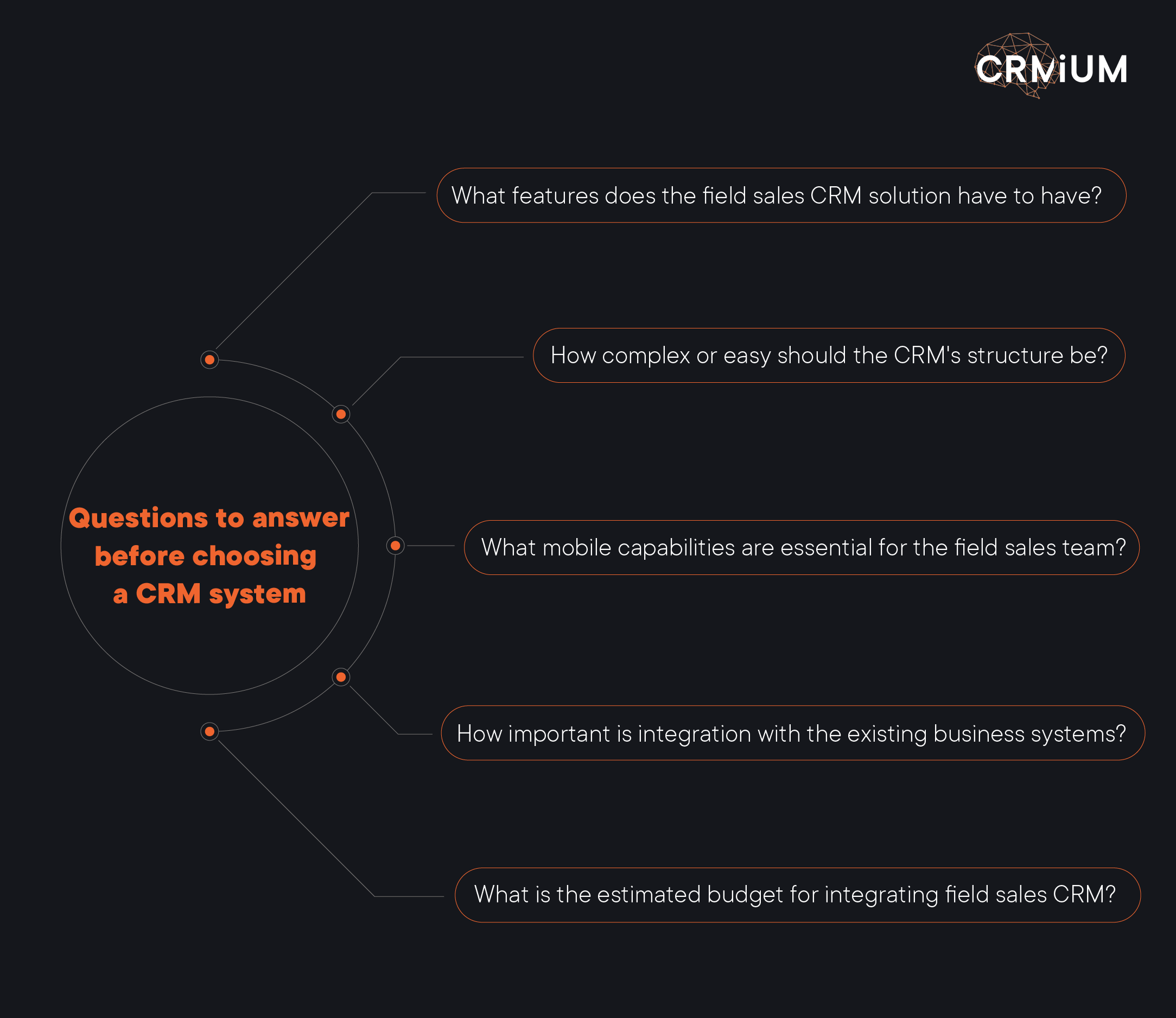
Selecting the right field sales CRM can easily streamline sales operations. But with so many options available, how do you make the best choice?
You should first assess your business capabilities by answering these questions:
- What features does the field sales CRM solution have to have?
Start by identifying the must-have capabilities your sales team can’t live without. Key features often include:
GPS tracking & mapping – to monitor the location and movement of sales reps on the go.
Lead management – to instantly capture and organize new potential customers during visits.
Visit scheduling – with automated route planning to maximize time efficiency.
Mobile reporting – to file reports immediately after a meeting, without waiting to return to the office.
- How complex or easy should the CRM’s structure be?
One of the most important factors when choosing a CRM for a field sales team is usability. If the system is too complex or cluttered, sales reps are less likely to use it consistently, and that means lost data, missed opportunities, and frustration. A good solution should be intuitive enough that reps can navigate the interface and access essential features quickly, even while on the move. Ideally, it should offer customizable dashboards, so your team only sees what they actually need, without unnecessary distractions.
Additionally, low-code or no-code capabilities are a major plus: they allow your business to tweak workflows or add features without needing to involve a developer every time, which saves both time and budget.
- What mobile capabilities are essential for the field sales team?
Since your sales representatives spend more time on the road than behind a desk, having strong mobile capabilities isn’t optional, but truly essential. A mobile-first CRM ensures your team can stay productive wherever they are. It should provide seamless access to customer profiles, order history, and notes directly from a smartphone or tablet, so reps can prepare for meetings or follow up without delays. Offline access is another key feature: sales reps shouldn’t worry about losing data or stopping work when there’s no internet connection.
Interestingly, 53% of surveyed salespeople said that using mobile CRM greatly improves the quality of their CRM data. Only 18% think that mobile CRM has minimal or no impact.
On top of that, real-time push notifications help them stay on top of tasks, schedule changes, and client updates, all in the palm of their hand. The right mobile features can distinguish between a missed opportunity and a closed deal.
- How important is integration with the existing business systems, like ERP, marketing automation, and third-party apps?
A customer relationship management system shouldn’t function as a standalone tool, as it needs to connect smoothly with the rest of your business ecosystem. Integration with ERP systems is especially important for sharing real-time order data and checking inventory levels. Likewise, linking your CRM with marketing automation platforms helps ensure that lead nurturing and campaigns stay aligned with your sales pipeline.
If your team already uses tools for delivery tracking, invoicing, or communication, the CRM should support integrations with those apps too. A well-integrated system reduces manual work, eliminates duplicate data entry, and keeps everyone on the same page: from sales reps in the field to back-office teams.
- What is the estimated budget for integrating field sales CRM?
Although price shouldn’t be the only deciding factor, having a defined budget from the start will help you focus on the right options. It’s worth considering CRM platforms that offer flexible pricing models, such as monthly subscriptions without long-term commitments, which allow you to scale up or down as needed. Keep in mind that the initial price tag doesn’t always reflect the total cost: onboarding, system implementation, and ongoing support can significantly impact the final investment.
That’s why it’s essential to evaluate the potential return on investment: think about how the CRM will help your sales team communicate faster, reduce inefficiencies, and streamline processes across departments. A well-chosen system should not only fit your budget but also drive measurable business growth.
Once you’ve outlined your requirements, compare them to the top Field Sales CRM solutions on the market. We advise you to pay attention to criteria like scalability, real-time data access, mobile capabilities, and pricing.
Need help choosing the best Field Sales CRM? Explore expert-recommended solutions today!
Top Field Sales CRM Software
Applying our experience and expertise in creating CRM solutions, we have created a top field sales CRM software so you can compare it and make the proper choice.
Creatio CRM
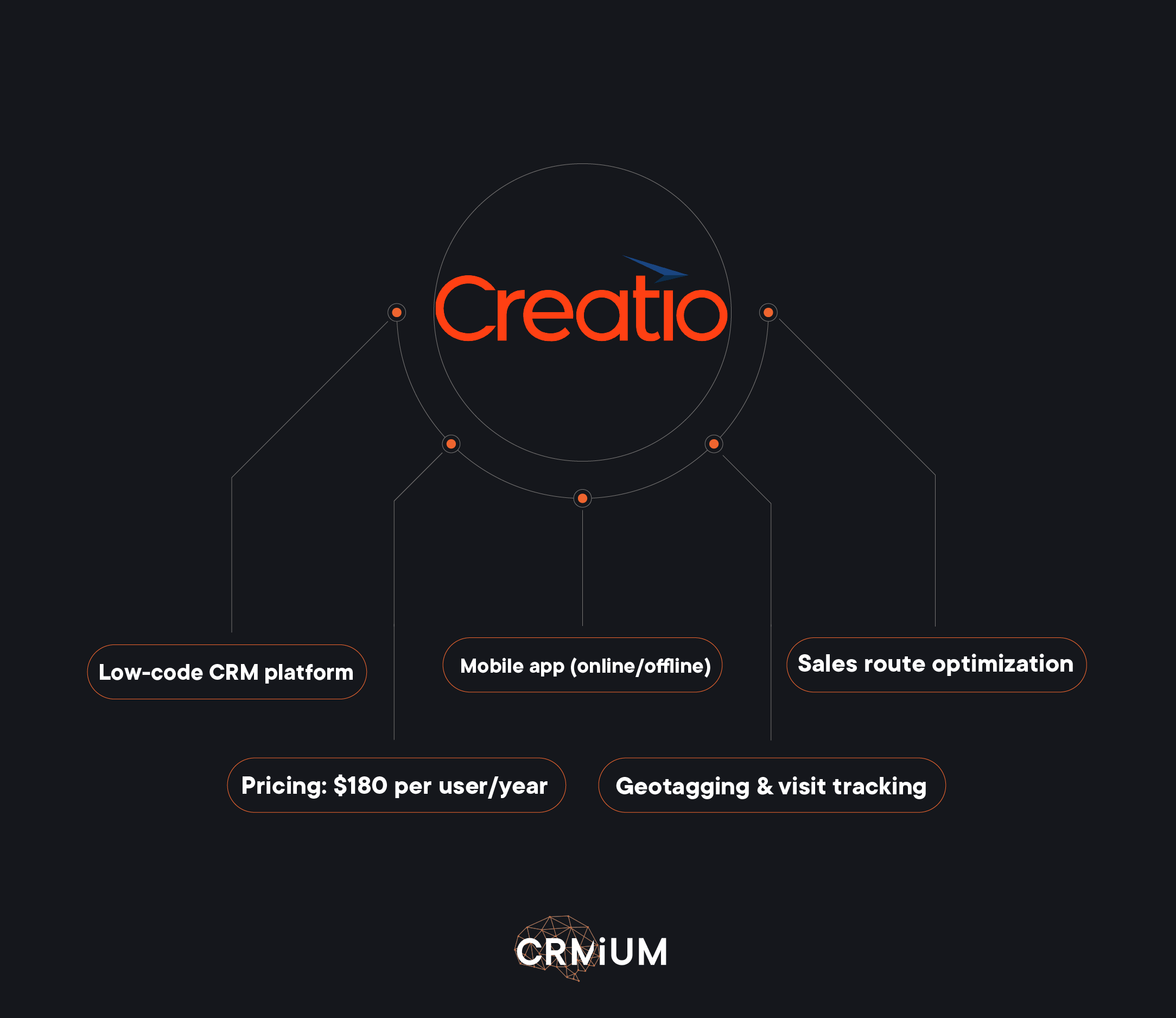
Creatio is a low-code CRM platform for sales, marketing, and service management. It offers strong workflow automation and customization, but can be complex to set up. While robust for enterprises, its out-of-the-box field sales tools could be unsuitable for small businesses.
Real-Time Data Access: Sales reps can log meeting details, monitor SKUs, and update orders instantly from a mobile device.
Mobile Capabilities: Works online and offline; enables check-ins, product selection, and order placement during visits.
Route Optimization: Plans visits, builds optimal routes on a map, and tracks reps via geotags.
Customization: Allows custom visit agendas, guidelines, and workflow automation for various customer categories.
Pricing: $180 per user/year; support available under “Basic,” “Business,” and “Premium” packages.
Zoho
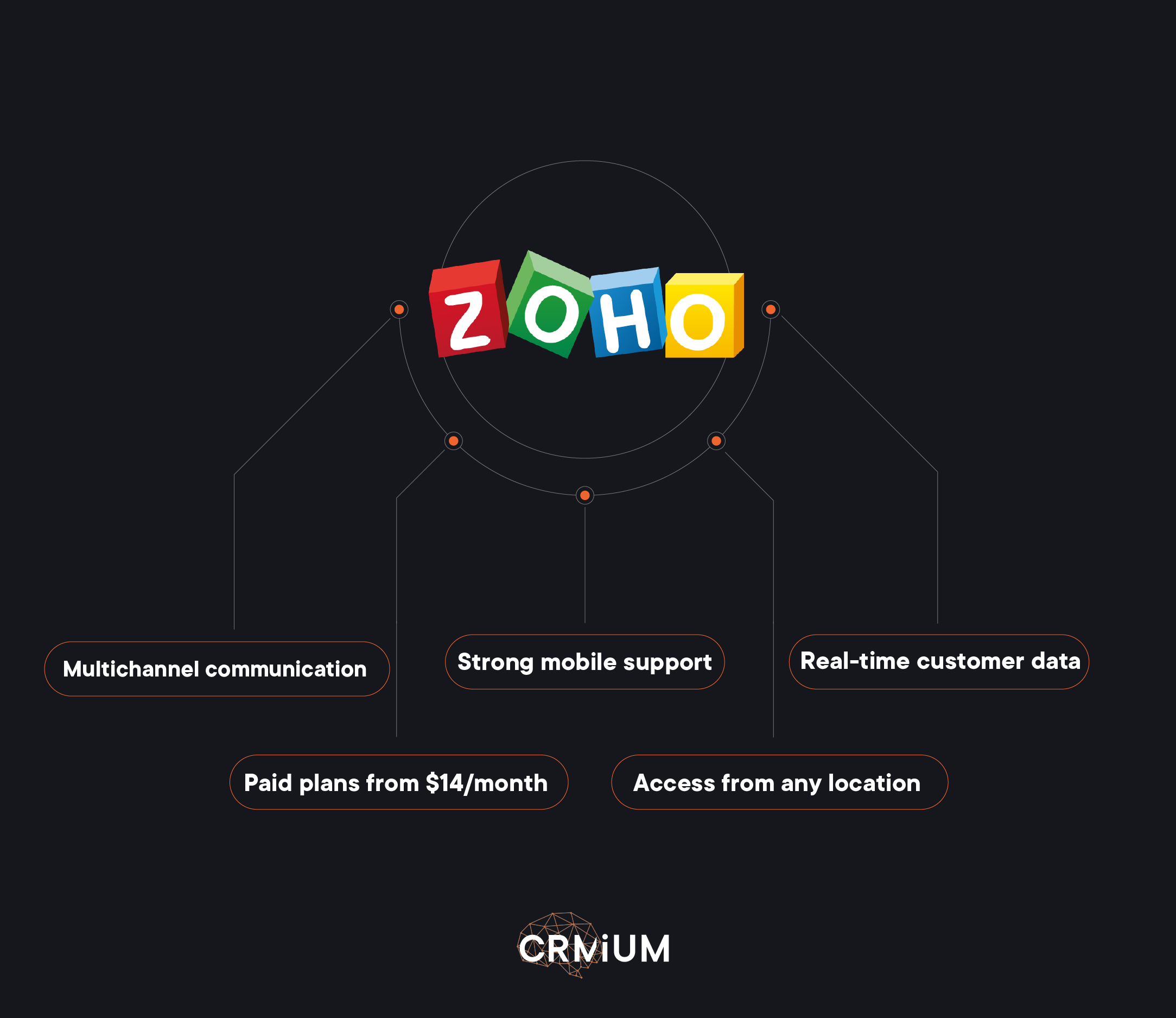
Zoho CRM is a comprehensive CRM platform offering multichannel communication. It provides strong mobile support and customization, making it a solid choice for field sales. While feature-rich, some advanced functionalities may require additional integrations or higher-tier plans.
Route Optimization: Identifies the fastest travel routes, enabling field sales reps to meet more prospects and customers.
Performance Insights: Offers sales managers insights into field activities and performance, aiding in territory optimization
Real-Time Data Access: Provides field sales reps with instant access to customer data on the road, allowing for personalized interactions during meetings
Mobile Capabilities: Enables field reps to access CRM data from any location from their mobile devices
Pricing:Zoho CRM offers a Free Edition for up to three users, with paid plans starting at $14 per user/month (billed annually)
Pipedrive
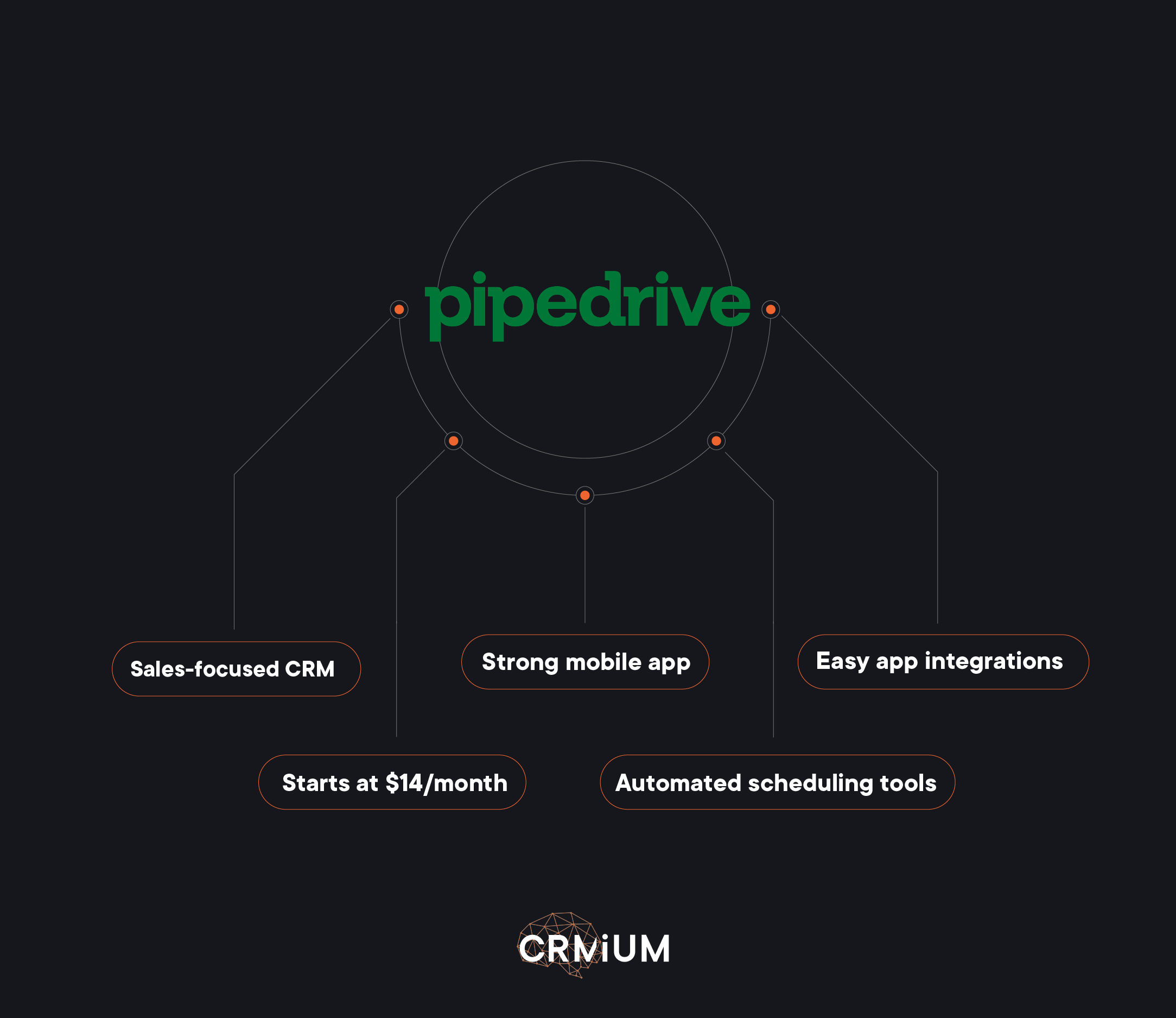
Pipedrive is a sales-focused CRM designed to automate workflows. It stands out for its strong pipeline management and excellent mobile device support. However, it lacks advanced customization features in more complex CRMs like Creatio.
Automate scheduling: The field sales CRM enables quick sharing with clients, setting up recurring meetings, and avoiding double-booking.
Integrations and add-ons: Supports Pipedrive integration with apps designed to empower customer relationship management, including customer support, email marketing campaigns, social media, and chatbots.
Real-Time Data Access: The platform provides instant access to customer data, enabling sales reps to plan their days, prioritize tasks, and maximize their time on the road.
Mobile Capabilities: Manage schedules, track tasks, and communicate with clients via Pipedrive’s mobile app.
Pricing: Plans start at $14 per user/month (billed annually), with tiers offering advanced features.
Best Practices for Using Field Sales CRM
Implementing a CRM system for field sales is a transformative step that can significantly improve your team’s performance and overall sales outcomes. To make the most of this solution, it’s essential to follow best practices that will ensure its effective use. Here are some key strategies to help maximize your sales efforts and drive better results:
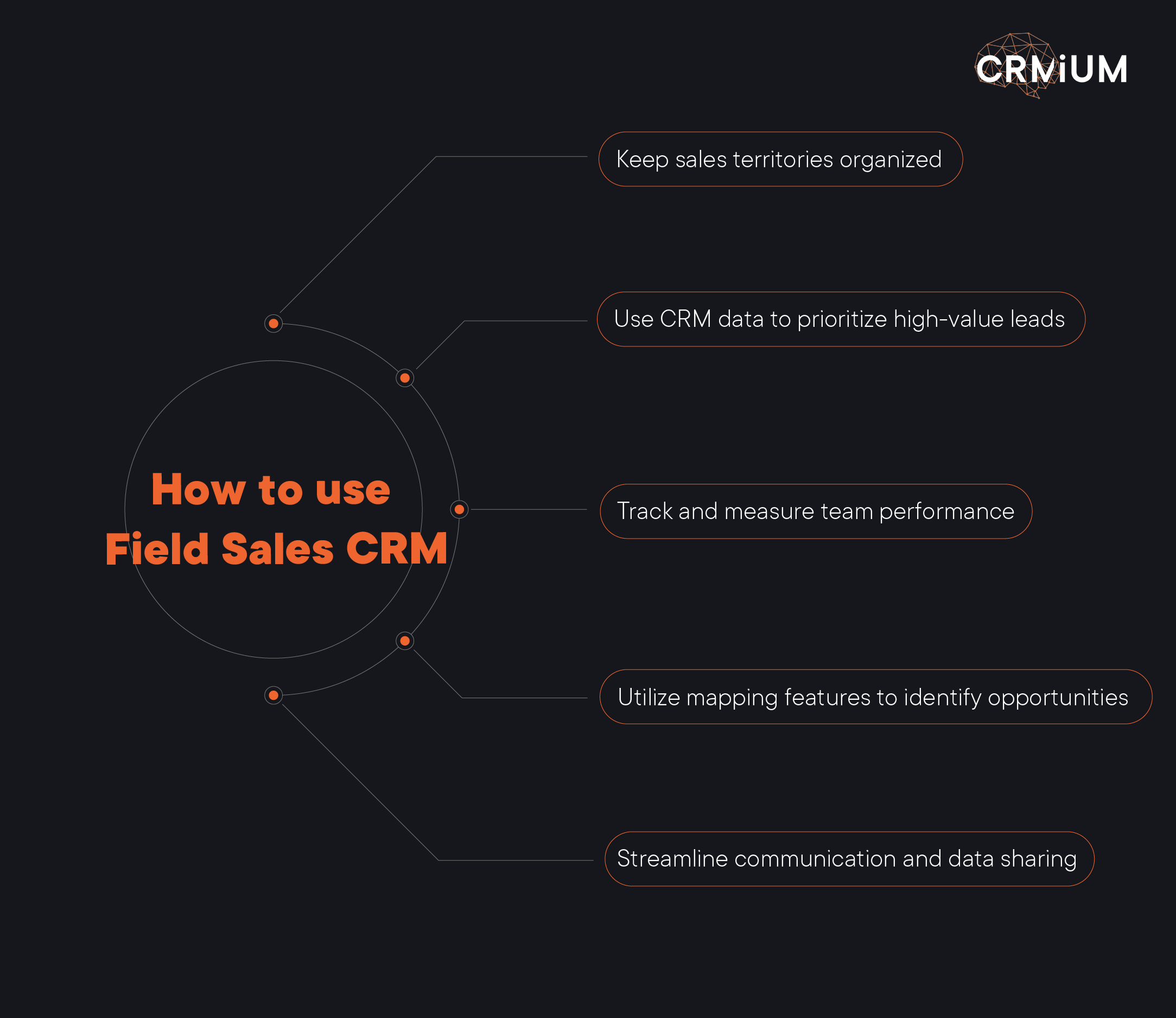
1. Keep Sales Territories Organized
One of the primary benefits of a CRM tailored for sales teams working outside of the office is the ability to effectively manage and organize sales territories. Segmenting territories based on factors such as geography, customer type, or business potential allows each sales representative to focus on a manageable set of prospects. This organization not only makes planning more efficient but also prevents overlaps and ensures that each sales rep can concentrate their efforts in the most profitable areas. A clear structure leads to better productivity and optimized sales routes.
2. Use CRM Data to Prioritize High-Value Leads
Sales success is often tied to focusing on the most promising opportunities. By leveraging data stored within the CRM, sales managers can easily identify high-value leads that are more likely to convert into profitable deals. Using the system’s data analysis tools, you can prioritize leads based on factors like their previous engagement, potential deal size, and specific needs. This enables sales teams to invest their time and effort in the opportunities with the greatest potential, boosting conversion rates and closing more deals.
3. Track and Measure Team Performance
To gauge the effectiveness of your sales strategy, it’s crucial to track team performance consistently. A robust CRM system provides sales managers with the ability to monitor the activities and progress of each sales rep. This includes tracking interactions with customers, the number of meetings scheduled, and the overall progress of deals. By setting clear key performance indicators (KPIs), you can assess whether the team is hitting targets, identify areas for improvement, and adjust strategies accordingly. Regularly measuring performance motivates the sales team and fosters a culture of accountability and continuous improvement.
4. Utilize Mapping Features to Identify Opportunities
Many CRM platforms come equipped with mapping functionalities that help visualize client locations, sales territories, and potential leads. These tools help identify areas where there are untapped prospects or where demand is higher. Sales representatives can optimize their travel routes, minimize downtime, and ensure they are meeting the right customers at the right time. By using these mapping features, the team can focus on maximizing efficiency and uncovering new opportunities that might otherwise be missed.
5. Streamline Communication and Data Sharing
In field sales, one of the common challenges is ensuring seamless communication between the sales team in the field and the rest of the organization. A CRM system centralizes all customer information, making it easily accessible for all team members. Whether it’s meeting notes, customer preferences, or the status of ongoing deals, everyone can stay up to date in real-time. This eliminates the risk of miscommunication and ensures that sales reps have all the information they need when interacting with clients. Additionally, mobile access allows field reps to stay connected and enter data while on the move.
6. Automate Routine Tasks and Follow-Ups
Repetitive tasks such as scheduling follow-up meetings or sending emails can take time away from actual selling. With a CRM solution, many of these tasks can be automated, allowing sales reps to focus more on engaging with clients. The system can automatically remind sales reps to follow up with leads, send emails, and update deal statuses, reducing the risk of oversight and ensuring that no opportunity slips through the cracks. This automation boosts efficiency and reduces the administrative burden on your team.
Effective Sales Pitch Techniques for Field Sales Representatives
In field sales, an effective sales pitch is a cornerstone of success. Field sales representatives must craft messages that speak directly to customer expectations, guided by sales data and real-time insights gathered during customer interactions. Outside sales reps who adapt their sales techniques to the context of each meeting build stronger customer relationships and improve their chances of closing deals. By positioning themselves as trusted advisors, not just sellers, they contribute to long-term customer engagement and repeat business.
Best CRM Tools for Field Sales Success
Choosing the best field sales CRM is essential for streamlining the sales process and enhancing efficiency. With the right tool, sales representatives can manage customer data, monitor team performance, and ensure no opportunities are missed. Top CRMs enable real-time insights, offering a comprehensive view of the sales pipeline and allowing sales teams to adapt quickly to changes. These tools provide valuable information on market research, prospective customers, and business development opportunities, helping sales teams stay ahead in a competitive environment.
Monitoring Sales Team Performance
For sales leaders, one of the key responsibilities is to monitor team performance. Using CRM systems, it’s easier to track individual progress, identify areas for improvement, and offer coaching where necessary. By measuring metrics such as call frequency, sales pitches, and closed deals, managers can better understand the effectiveness of sales engagement strategies and relationship-building efforts. Furthermore, sales leaders can identify patterns and optimize the sales process, ensuring that the outside sales team remains aligned with the overall business objectives.
Adapting to Longer Sales Cycles
In many industries, especially those with complex products or services, sales cycles can be long. Field sales teams need to be equipped to manage these longer sales cycles effectively. A CRM system designed for outside sales teams allows sales reps to track each interaction over time, ensuring they stay engaged and connected with prospective customers throughout the process. By maintaining personal connections and leveraging historical data, sales reps can build trust and stay top of mind, even when the decision-making process is lengthy.
Building Strong Relationships and Expanding Market Reach
At the heart of field sales lies strong customer relationship building. The ability to cultivate strong, personal relationships with clients is essential for securing repeat business and fostering long-term customer loyalty. Outside sales representatives who focus on establishing these relationships, rather than just pushing products, create value for their customers and their business. Building a network of trusted clients also helps teams gain a better understanding of industry needs and trends, positioning them for success in future opportunities.
For field sales to be successful, they need the right tools and strategies. By using advanced CRM solutions, reps can not only enhance their productivity but also adapt their approach based on real-time insights, monitor their progress, and create deeper relationships with customers. The combination of effective sales pitches and data-driven decision-making is essential for achieving sales success and driving business growth in today’s competitive marketplace.
Sales organizations must go beyond hitting quotas. They need to focus on building customer relationships that are authentic, strategic, and long-lasting. For outside sales representatives, this means mastering the balance between data-driven efficiency and personal connections. Whether dealing with prospective clients or nurturing existing customers, the ability to understand a prospect’s pain points and adapt communication accordingly is critical for standing out.
A well-developed field sales strategy supported by reliable field sales software enables sales staff to work smarter, not harder. With tools that offer real-time insights and clear visibility into field sales performance, account executives and team leaders can make informed decisions, adapt quickly to market trends, and prioritize time management. Efficient field sales management ensures that no opportunity is missed, even in longer sales cycles that demand ongoing engagement and follow-up.
While inside sales teams can rely heavily on digital communication, outside reps thrive on in-person interactions. Attending industry conferences, conducting face-to-face meetings, and gathering customer feedback all play a role in relationship-building and establishing trust. These personal relationships are often what turn initial interest into successful deals and repeat business, contributing directly to business growth and competitive advantage.
Finally, strong sales engagement tactics should align with the broader goals of business development. By leveraging CRM systems to manage leads, track interactions, and monitor performance, sales leaders ensure that every effort contributes to achieving objectives.
Understanding what motivates prospective customers and maintaining close communication throughout the journey allows outside sales teams to increase the average deal size while laying the groundwork for long-term success.
Conclusion
A well-implemented CRM system designed for sales teams in the field can significantly enhance the efficiency and effectiveness of your sales process. By keeping sales territories organized, prioritizing high-value leads, tracking performance, utilizing mapping features, and automating tasks, sales reps can focus on what truly matters: building strong relationships and closing deals.
For businesses looking to maximize the potential of their sales teams, trusted CRM integrators like CRMiUM are tailored to help field sales succeed. Explore how CRMiUM’s team can help your business team unlock its full potential today!
Got Questions? We’ve Got Answers
What is the main difference between an office CRM and a CRM for field sales?
While traditional CRMs are designed for desk-based work, a Field Sales CRM is mobile-first. It includes specialized features like GPS mapping, route optimization, and instant mobile reporting. It allows reps to access full client histories and update deal statuses on the go, without ever needing to return to an office desk.
How does route optimization actually help save money for my business?
It eliminates inefficient "zigzag" travel across territories. By calculating the most logical path between appointments, the CRM reduces fuel consumption and vehicle wear while maximizing the number of meetings a rep can attend per day. This leads to lower operational costs and significantly higher sales potential.
Can sales reps work in the CRM if they lose internet connection in remote areas?
Yes, top-tier solutions like Creatio and Zoho offer robust offline capabilities. Sales reps can view client profiles and enter meeting notes without a signal. Once the device reconnects to the internet, the system automatically syncs the data, ensuring no information is lost and avoiding manual data entry later.
What are the "must-have" mobile features for a traveling sales team?
The essentials are GPS integration for location tracking, mobile lead management for capturing data during visits, and appointment scheduling with automated route planning. Real-time push notifications are also crucial to keep reps updated on last-minute schedule changes or urgent client requests.
How do I choose between Zoho, Pipedrive, and Creatio for my field team?
The choice depends on your business complexity. Pipedrive is ideal for teams seeking simplicity and visual pipeline management. Zoho CRM offers a balanced, highly customizable ecosystem. Creatio is perfect for larger enterprises that require deep process automation and complex "no-code" configurations.
Is a field sales CRM effective for small businesses, or is it just for large enterprises?
It is a game-changer for both. Statistics show that mobile CRM adoption can enable a team of two salespeople to reach targets that previously required seven. For small businesses, this massive boost in productivity provides a significant competitive advantage and a high return on investment.


